
Dip and Dry in Lateral Flow Test Manufacturing: When Should You Use Soaking Instead of Spraying?
Pad treatment is one of the most important preparation steps in lateral flow test manufacturing. Whether the production process involves conjugate pads, sample pads, or other absorbent materials, the way treatment solution is applied and dried can directly influence consistency in downstream production.
As manufacturers move from laboratory-scale development to larger-volume production, pad treatment also becomes more challenging. It is no longer only a question of applying reagent to the material. Manufacturers must also consider treatment uniformity, drying stability, material handling, production speed, and whether the process should use spraying or soaking.
This is why dip and dry systems are increasingly important in modern lateral flow production lines. In this article, we look at how dip and dry processing works, when soaking may be more suitable than spraying, and how reel-format equipment can support large-scale pad treatment.
1. Why Is Pad Treatment Important in Lateral Flow Manufacturing?
In many rapid test manufacturing processes, pads must be treated with a defined solution before they are assembled into the final test strip. Depending on the application, this treatment may help adjust flow behavior, support reagent release, improve sample compatibility, or prepare the material for downstream use.
Even when the formulation itself is appropriate, inconsistent application or uneven drying can still create variation between different sections of the material. In larger-scale manufacturing, this may affect reproducibility and increase the difficulty of process control.
For this reason, manufacturers often need a pad treatment process that is not only effective, but also repeatable, scalable, and compatible with continuous production.
2. What Does a Dip and Dry Process Involve?
A typical dip and dry process includes several connected stages. Reel-format material is first fed into the system, then treated by either spraying or soaking, followed by controlled drying. After drying, the material can be cut or rewound for the next production step.
For large-scale production, these stages are often integrated into one continuous workflow so that the material can move through treatment and drying under more controlled conditions.
| Production Stage | Typical Function |
|---|---|
| Material Feeding | Feeds reel-format pad material into the treatment process. |
| Solution Spraying or Soaking | Applies treatment solution to the material using the selected process. |
| Drying | Removes moisture under controlled conditions to improve consistency. |
| Cutting or Rewinding | Prepares treated material for subsequent lamination, assembly, or storage. |
3. Spraying vs. Soaking: What Is the Difference?
Both spraying and soaking are used in pad treatment, but they are not exactly the same in process logic or typical application.
3.1 Spraying
In a spraying process, treatment solution is applied to the material surface in a controlled and quantitative way. This can be useful when the manufacturer needs more precise solution delivery or wants to limit the total amount of liquid added to the material.
For continuous production, spraying is often combined with pump-controlled delivery and process monitoring in order to maintain more stable application performance.
3.2 Soaking
In a soaking process, the pad material passes through or is immersed in a treatment tank so that the material can absorb the solution more fully. This approach may be preferred when the treatment process requires full contact between the material and the solution.
Soaking can be especially useful for reel-format materials when manufacturers want a more complete treatment process before drying.
4. When Might Soaking Be Preferred Over Spraying?
A soaking process may be more suitable in several common situations.
- Full material contact is required: the process needs the treatment solution to penetrate the material more completely.
- Reel-format processing is used: the manufacturer is treating continuous pad material rather than individual sheets.
- Large-scale production is planned: the line needs a stable and repeatable treatment process for higher throughput.
- The process requires flexibility: the same equipment may need to support both spraying and soaking according to different projects.
That said, spraying remains useful in many applications, especially when quantitative solution delivery and controlled application are important. In practice, manufacturers often select the process after considering both the formulation and the production workflow.
5. Why Does Drying Consistency Matter?
Applying the solution is only one part of pad treatment. Drying is equally important because uneven or unstable drying conditions can introduce variation across the treated material.
In large-scale production, manufacturers typically need the drying section to maintain stable temperature conditions over the full treatment path. If the material is dried unevenly, different sections of the same reel may show different characteristics in downstream production.
For this reason, drying systems are often designed with multiple monitoring points and a defined drying distance so that the process can be better controlled.
6. What Challenges Appear in Large-Scale Pad Treatment?
As production increases, pad treatment becomes more than a simple laboratory operation. Several challenges become more important at scale.
- Material handling: reel-format material must move through the process at a moderate and consistent speed.
- Solution consistency: treatment liquid delivery should remain stable throughout production.
- Drying control: large drying sections must maintain stable and homogeneous conditions.
- Process monitoring: manufacturers need better visibility into flow deviations and application performance.
- Process flexibility: different materials or products may require different treatment modes.
This is one reason why standalone manual methods often become less suitable as manufacturers move toward larger and more continuous production lines.
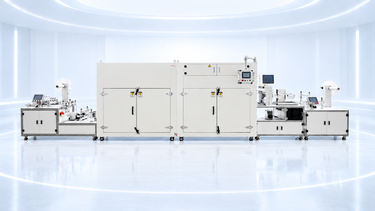
7. Reel Pad Dip and Dry Machine LZHD022
The Veldi Reel Pad Dip and Dry Machine LZHD022 is designed for reel-format pad treatment in rapid diagnostic test manufacturing. It is suitable for large-scale production and integrates multiple treatment stages into one workflow.
A standard configuration includes material feeding, solution spraying or soaking, two drying ovens, and material cutting or rewinding. This allows the treatment process to be completed in a more continuous and production-oriented manner.
Typical Features of LZHD022
- Designed for super large-scale production.
- Each working section is designed separately for easier installation and uninstallation.
- Several temperature monitoring points are placed in the drying oven to help support a homogeneous drying process.
- Quantitative reagent spraying is controlled by peristaltic pumps.
- A fluid monitor can report deviations in flow to help maintain consistent spraying performance.
- The same machine can also be configured for treatment by soaking with a soaking tank.
- CCD can be used to monitor spraying performance automatically.
- Material feeding and rewinding are realized by a stepper motor for moderate and consistent running speed.
- The equipment is customized according to project requirements.
LZHD022 Technical Specifications
| Power Supply | 380V, 33 kW |
|---|---|
| Running Speed | 5–25 mm/s |
| Equipment Dimensions | 8140 × 1100 × 1950 mm |
| Distance in Two Drying Ovens | 28 meters |
| Treatment Mode | Spraying or soaking |
| Output Format | Material cutting or rewinding |
8. When Should a Manufacturer Consider a Reel Dip and Dry System?
A reel dip and dry system may be worth considering when the manufacturer is moving beyond small-batch manual treatment and needs a more continuous pad-processing workflow.
- Production volume is increasing;
- The process requires reel-format material handling;
- More consistent treatment and drying are needed;
- The manufacturer wants both spraying and soaking flexibility;
- Downstream production is becoming more automated.
Selecting the right configuration still depends on the product type, treatment objective, material format, and desired production capacity.
9. Dip and Dry Is One Part of a Complete Manufacturing Process
Pad treatment is only one stage in a larger lateral flow production workflow. After treatment and drying, the material may continue into lamination, strip cutting, assembly, pouching, or other downstream processes depending on the product design.
Manufacturers therefore benefit most when pad treatment is considered together with the rest of the production line, rather than as an isolated stand-alone operation.
Conclusion
As lateral flow test manufacturing moves toward greater automation and larger production capacity, pad treatment must also become more controlled and scalable. The choice between spraying and soaking is not only a formulation question, but also a production-process decision.
For reel-format production, a dip and dry system can help manufacturers combine solution treatment, drying, and material handling into a more continuous workflow. When configured correctly, this can support more stable large-scale production.
The Veldi Reel Pad Dip and Dry Machine LZHD022 is designed for this type of application, offering spraying or soaking treatment modes together with drying, feeding, and rewinding or cutting functions for large-scale pad processing.
Need a Large-Scale Pad Treatment Solution for Rapid Test Manufacturing?
Veldi Automation provides equipment and customized automation solutions for rapid diagnostic test manufacturing, including dispensing, pad treatment, lamination, cutting, assembly, pouching, and integrated production workflows.
Explore more equipment in our Dip and Dry Machine Collection or contact our team to discuss your material format, treatment method, and production capacity.
Blog Information
Leave your contact information and tell us what equipment or raw materials you are looking for. We will contact you as soon as possible to help you provide the most suitable solution.
- +86 13671664698
- inquiry@veldiautomation.com