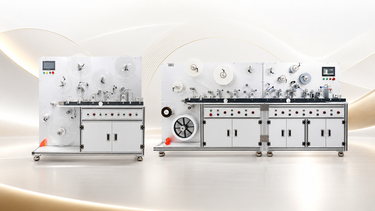
As lateral flow assay production moves from laboratory development to pilot production and commercial manufacturing, lamination often becomes one of the first processes to limit capacity. Manual positioning may be suitable for early development, but increasing order volumes require faster material feeding, more consistent overlap, and better control of strip construction.
An automated LFA laminator helps manufacturers increase production capacity without simply adding more operators. By continuously feeding the backing card, nitrocellulose membrane, conjugate pad, sample pad, absorbent pad, and other materials, the machine can improve both throughput and assembly consistency.
However, production expansion is not only about purchasing a faster machine. The laminator must match the strip structure, material format, downstream cutting process, inspection requirements, and expected production scale. Choosing the correct lamination configuration is therefore an important part of planning an efficient LFA production line.
1. Why Lamination Becomes a Bottleneck During LFA Scale-Up
During early-stage development, operators may laminate lateral flow materials manually with a positioning jig. This approach is flexible and economical when the production volume is low or when strip structures are still being adjusted.
As production volumes increase, however, manual lamination can create several limitations:
- Production speed depends heavily on operator experience.
- The overlap between the membrane, sample pad, conjugate pad, and absorbent pad may vary.
- Material positioning may gradually shift during long production batches.
- Repeated handling increases the risk of contamination, wrinkles, and adhesive exposure.
- Production records and output counting are more difficult to standardize.
- Adding more workers does not always produce a proportional increase in output.
An automated laminator addresses these problems by controlling feeding, alignment, tension, pressing, and material positioning through a repeatable mechanical process. This allows the lamination stage to support higher-volume downstream cutting and assembly operations.
2. How an Automated LFA Laminator Increases Production Capacity
An automatic reel-to-card laminator increases capacity in several ways. The most visible improvement is continuous material feeding, but the larger benefit is the standardization of the overall lamination process.
Continuous Material Feeding
Roll-format materials can be mounted on adjustable spindles and guided into the lamination section. This reduces the number of interruptions required for manual positioning and allows longer production runs.
Controlled Material Alignment
Deviation-correction devices help control the position of the NC membrane and other reel-fed materials. Stable alignment is particularly important because even a small displacement can change the overlap between functional components and affect sample flow.
Consistent Lamination Pressure
Pressure rollers help ensure that each component adheres securely to the backing card. Consistent pressure reduces the risk of loose material, air gaps, wrinkles, or uneven adhesion.
Reduced Dependence on Manual Operation
Operators remain responsible for material loading, setup, monitoring, and changeover, but they no longer need to manually position every master card. This allows the same production team to manage a higher output.
Improved Batch Repeatability
Once the feeding positions and process parameters have been validated, they can be reused for future batches. This helps manufacturers establish standard operating procedures and reduces variation between operators and production shifts.
3. Choosing Between a Five-Component and Seven-Component Laminator
The correct machine configuration depends mainly on the structure of the lateral flow product. A standard cassette-based rapid test usually requires fewer laminated materials than a dipstick or multi-layer product containing additional covering or marking films.
| Comparison | ZJZT005 Five-Component Laminator | ZJZT007 Seven-Component Laminator |
| Main application | Standard lateral flow strip and cassette production | More complex strip structures, including dipstick-type products |
| Material configuration | Backing card with NC membrane, conjugate pad, sample pad and absorbent pad | Standard LFA materials plus two additional sticker or covering films |
| Backing card format | Reel-format or manually fed sheet-format backing card | Primarily designed for reel-format backing card |
| Nominal speed | 100 mm/s | 83 mm/s |
| Lamination precision | ±0.1 mm | ±0.1 mm |
| Vision inspection | Configured according to project requirements | Optional inspection before the conjugate pad is covered by the marking film |
| Equipment dimensions | 1600 × 670 × 1575 mm | 2000 × 640 × 1500 mm |
4. ZJZT005 for Standard LFA Production Expansion
The ZJZT005 Reel-to-Card Five-Component Laminator is designed for standard lateral flow strip constructions. It laminates the principal functional materials onto a reel-format or sheet-format backing card.
For reel-format production, the backing card is fed from an adjustable spindle and passes through guides and pressure rollers. When sheet-format backing cards are used, the sheets can be fed manually. After lamination, the assembled material travels through the conveyor and can be divided into master cards for the next cutting process.
This configuration is suitable for manufacturers that are moving from manual lamination toward stable pilot or commercial production. Typical applications include cassette-based rapid tests using:
- Self-adhesive backing card
- Nitrocellulose membrane
- Conjugate pad
- Sample pad
- Absorbent pad
With a nominal operating speed of 100 mm/s and lamination precision of ±0.1 mm, the machine can support higher production volumes while maintaining controlled material placement. Panasonic PLC control, optical fiber sensors, a stepper motor, a touch-screen interface, and an integrated counting function also help improve production monitoring and repeatability.
5. ZJZT007 for More Complex Seven-Component Products
The ZJZT007 Reel-to-Card Seven-Component Laminator is intended for products that require more material layers than a standard lateral flow cassette strip.
In addition to the absorbent pad, NC membrane, conjugate pad, and sample pad, the system can laminate two additional sticker films. This configuration is particularly relevant for certain dipstick-type products or other formats in which functional materials must be partially covered after lamination.
An optional vision inspection device can be installed to inspect the conjugate pad before it becomes covered by the marking sticker. This is useful when the material will no longer be visible later in the production process.
The ZJZT007 is therefore suitable for manufacturers expanding into more complex product structures, multiple product formats, or higher levels of in-process quality control. Its working platform can also be customized according to material layout and production requirements.
6. Three Practical Ways to Expand an Existing LFA Production Line
Replace Manual Lamination with Automated Lamination
For manufacturers currently using manual lamination jigs, the most direct expansion method is to transfer validated material positions to an automatic laminator. The manual jig can still be retained for R&D, trial batches, troubleshooting, and new product development.
This creates a practical division between development and production:
Manual lamination jig: formulation development, material evaluation, process adjustment and small trial batches.
Automatic laminator: validated products, repeat production, commercial batches and continuous manufacturing.
Add a Dedicated Laminator for a New Product Format
When an existing production line already manufactures standard cassette tests, a second laminator can be used for dipstick products, multi-layer strips, veterinary tests, or other products with different material structures.
Separating product formats can reduce changeover frequency and prevent frequent adjustments to spindle positions, guiding structures, and lamination settings.
Install Parallel Lamination Capacity
For established products with stable demand, manufacturers can add another laminator in parallel. One machine can continue production while the other is used for another batch, material changeover, preventive maintenance, or urgent orders. Parallel equipment also reduces the risk that a single lamination station will stop the entire production line.
7. Balance the Laminator with Downstream Equipment
Increasing lamination speed does not automatically increase the output of the complete production line. The downstream processes must be able to handle the additional laminated material.
The following equipment should be evaluated when expanding lamination capacity:
- Strip cutter: The cutting capacity must match the quantity of laminated master cards.
- Cassette assembly machine: Strip loading and cassette pressing should not become the next bottleneck.
- Vision inspection system: Additional inspection may be required as production speed increases.
- Pouching and sealing machine: Packaging capacity should correspond to the higher strip output.
- Drying and material preparation: NC membrane, conjugate pad, and sample pad preparation must be completed before lamination begins.
A balanced production line should maintain sufficient capacity at every stage rather than maximizing the speed of only one machine.
8. Validate Materials Before Full-Scale Production
Different backing cards, membranes, glass fiber pads, polyester pads, absorbent papers, and sticker films behave differently during continuous lamination. Their thickness, stiffness, roll tension, adhesive strength, and dimensional stability can influence machine performance.
Before starting commercial production, manufacturers should validate:
- Material roll width and winding direction
- Backing card adhesive exposure
- NC membrane alignment and overlap
- Pad-to-membrane contact distance
- Feeding tension and deviation correction
- Lamination pressure
- Master card length
- Compatibility with the downstream strip cutter
A short pilot production run should be completed before continuous production. The laminated master cards should then be evaluated through cutting, cassette assembly, sample-flow testing, and finished-product performance testing.
9. Important Quality Controls During Automated Lamination
Automation improves repeatability, but it does not remove the need for process monitoring. Operators should inspect the laminated material at defined intervals and record any deviation.
Important control points include:
- The position of each material on the backing card
- The overlap between adjacent functional components
- Wrinkles, bubbles, lifting edges, or loose adhesion
- Roll tension and stable material feeding
- Cleanliness of guides and pressure rollers
- Sensor response and correction-device performance
- Conjugate pad visibility before covering-film lamination
For complex seven-component products, vision inspection can provide an additional verification step before critical materials become covered and can no longer be checked directly.
10. Plan Capacity Based on the Complete Manufacturing Process
The nominal machine speed should not be treated as the final number of test strips produced per hour. Actual output depends on the master card dimensions, strip width, product structure, loading time, material changeover, inspection frequency, equipment utilization, and downstream cutting capacity.
A realistic capacity plan should therefore include:
- Effective running time per shift
- Material loading and roll replacement time
- Product changeover time
- Inspection and sampling requirements
- Expected rejection rate
- Cutting and assembly capacity
- Preventive maintenance schedule
This approach prevents the laminator from producing more master cards than the downstream process can consume and helps manufacturers invest in equipment according to actual production demand.
11. Selecting the Right Expansion Strategy
The ZJZT005 is generally suitable for manufacturers producing standard lateral flow test strips with conventional material structures. It provides a practical transition from manual lamination to repeatable automatic production and can work with both reel-format and sheet-format backing cards.
The ZJZT007 is more appropriate when the product contains additional sticker films, requires a seven-component structure, or needs optional inspection before a critical layer is covered. It also provides greater flexibility for manufacturers planning to develop multiple strip formats.
The final selection should be based on the actual strip drawing, material dimensions, roll specifications, master card size, expected output, and downstream production arrangement.
12. Conclusion
An automated LFA laminator can significantly improve production capacity, but its greatest value is the ability to create a controlled and repeatable manufacturing process. Continuous feeding, deviation correction, stable pressure, touch-screen operation, and standardized material positioning allow manufacturers to move beyond the limitations of manual assembly.
For standard cassette-based lateral flow products, a five-component laminator provides an efficient route from pilot production to commercial manufacturing. For products with additional covering films or more complex strip structures, a seven-component laminator offers greater process flexibility and optional in-line inspection.
Before selecting a laminator, manufacturers should evaluate the complete production process rather than only the nominal machine speed. Matching the laminator with validated materials, cutting equipment, cassette assembly, inspection, and packaging processes is the most reliable way to achieve sustainable production expansion. For product-specific machine configuration, manufacturers can provide the strip structure drawing, material dimensions, backing card format, and expected capacity to Veldi Automation for further evaluation.