
Why Packaging Matters in Lateral Flow Test Stability: Moisture, Desiccants and Foil Pouches
A lateral flow test may appear complete once the strip has been assembled into a plastic cassette. From a manufacturing perspective, however, this is not the end of the process.
Before the test reaches the user, it may need to remain stable during storage, transportation, and changing environmental conditions. For many lateral flow products, the individual foil pouch, desiccant, and sealing process therefore form an important part of the final product configuration.
Packaging should not be treated simply as the final cosmetic step. It helps protect the finished assay between production and actual use, making packaging consistency an important consideration in commercial rapid test manufacturing.
1. Why Moisture Matters After a Lateral Flow Test Is Manufactured
A typical lateral flow strip contains several functional materials, including the sample pad, conjugate pad, nitrocellulose membrane, absorbent pad, and dried biological or chemical reagents.
Many of these materials are sensitive to their surrounding environment. Antibodies, antigens, conjugates, buffers, sugars, surfactants, and other dried reagents may be affected if they are exposed to unsuitable humidity conditions for extended periods.
This means that good dispensing, drying, lamination, cutting, and cassette assembly alone cannot guarantee the condition of the test throughout its intended storage period.
Key point: A well-produced test strip can still face stability problems if the post-assembly packaging process is not properly controlled.
2. What Does the Foil Pouch Actually Do?
Individual foil pouches are widely used for lateral flow tests because the packaged device needs to remain separated from the external environment until it is ready for use.
The purpose is not simply to place the cassette inside a bag. The packaging system must maintain suitable barrier performance throughout the product's intended storage period.
Several variables can affect the finished package, including pouch material, pouch dimensions, cassette positioning, seal temperature, sealing pressure, sealing time, and the condition of the sealing area.
Even a suitable foil structure cannot provide its intended protection if the pouch is incorrectly positioned or the seal is incomplete. This is why pouch handling and sealing repeatability become increasingly important as production volume grows.
3. Why Is a Desiccant Included in Rapid Test Packaging?
The desiccant inside a lateral flow test pouch helps control humidity within the sealed package. It should be viewed as one part of the overall packaging system rather than as a replacement for suitable pouch material or reliable sealing.
In simplified terms, the foil pouch limits interaction with the surrounding environment, while the desiccant helps manage moisture inside the package.
However, simply inserting a desiccant does not automatically guarantee product stability. The appropriate desiccant specification, pouch structure, sealing parameters, storage conditions, and claimed shelf life still need to be determined according to the specific assay and validated by the manufacturer.
Important: Packaging automation can improve process consistency, but the final shelf-life claim must still be established through product-specific stability studies and validation.
4. Why Packaging Becomes More Difficult as Production Scales
During R&D or pilot production, operators may manually place a cassette and desiccant into each pouch and then complete the sealing process separately.
This can be practical for small batches. As production volume increases, however, repeated manual operations introduce more opportunities for variation.
Common production risks can include:
- Missing desiccants or accessories;
- Incorrect cassette or pouch orientation;
- Inconsistent component placement;
- Variation in sealing position;
- Additional manual handling between cassette assembly and packaging;
- Difficulty maintaining consistent output over long production runs.
For higher-volume production, the main challenge is therefore not only packaging speed. It is maintaining repeatable packaging conditions across thousands of finished tests.
5. Why Connect Cassette Assembly Directly With Pouching?
Packaging quality actually starts before the pouch is sealed.
If a cassette contains a misplaced strip, an assembly defect, or an incorrect component, a perfectly sealed pouch will simply protect a defective finished product. For this reason, cassette assembly, inspection, component loading, and pouching can be considered as connected downstream manufacturing processes.
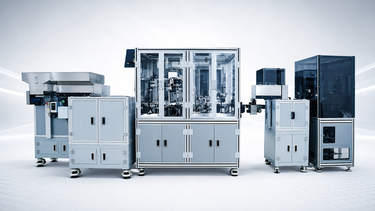
The Veldi ZKZD100 Cassette Assembly and Pouching Machine combines automated cassette assembly with subsequent pouch packaging, helping reduce repeated manual transfer between these two stages.
The system combines the ZK100 cassette assembly section with the ZD100 automatic pouching section, allowing assembled rapid test cassettes to continue into downstream packaging as part of a connected production workflow.
6. Inspection Before Packaging Is Just as Important as Sealing
During cassette assembly, automated feeding and positioning need to remain consistent so that the test strip is correctly placed before the upper and lower cassette components are closed.
The ZKZD100 incorporates vision inspection within the assembly process so that relevant assembly conditions can be checked before the product proceeds further downstream. Nonconforming products can then be identified and rejected instead of continuing directly into packaging.
This creates a more complete quality-control sequence:
The objective is not only faster production, but also reducing the possibility that an assembly defect becomes a packaged finished product.
7. What Happens During the Automatic Pouching Process?
The pouching section is designed to automate several repeated operations that would otherwise require manual handling.
Depending on the product configuration, the packaging process can involve:
- Rapid test cassette feeding;
- Desiccant feeding;
- Pipette or other accessory feeding;
- Aluminum foil pouch handling;
- Component insertion;
- Pouch positioning and heat sealing.
For the ZD100 pouching section used with the ZKZD100, the pouch is positioned before hot sealing to reduce unnecessary movement during the sealing process and improve repeatability of the final seal position.
An optional weighing inspection can also be added after packaging to help identify packages with missing components, providing another quality-control point at the end of the downstream process.
8. Automation Improves Consistency, but It Does Not Replace Environmental Control
An automatic pouching machine controls mechanical handling, component loading, positioning, and sealing. It does not independently control the humidity of the production environment.
If a particular assay requires low-humidity handling before packaging, suitable environmental controls and validated operating procedures are still required.
The same principle applies to shelf life. Consistent insertion of desiccants and repeatable sealing can support a controlled manufacturing process, but they do not independently determine how long a specific test can be stored.
Automation improves manufacturing consistency. Validation demonstrates product stability.
9. Packaging Should Be Considered During Product Design
Packaging decisions are best considered before a rapid test reaches large-scale production.
Different products may use different cassette dimensions, pouch sizes, desiccant formats, pipettes, droppers, or other accessories. These differences affect not only the finished package but also automatic feeding, positioning, inspection, and sealing.
A packaging configuration that is easy to handle manually may not always be equally suitable for automated feeding. For manufacturers planning to move from pilot production to continuous manufacturing, it is therefore useful to consider cassette design, pouch dimensions, desiccant format, accessory placement, and equipment configuration together.
The ZKZD100 can be configured according to different rapid test production requirements, allowing the cassette assembly and pouching workflow to be adapted around the customer's actual product design and packaging process.
10. From an Assembled Cassette to a Protected Finished Product
Dispensing determines where reagents are applied. Lamination determines how functional materials overlap. Cutting determines strip dimensions. Cassette assembly determines how the strip is positioned and mechanically protected.
But after these processes are complete, the test still needs to remain in its intended condition until the user opens the pouch.
That is why foil pouches, desiccants, sealing quality, and packaging consistency deserve the same manufacturing attention as earlier stages of lateral flow production.
For low-volume production, manual packaging may remain practical. As production volume increases, integrating cassette assembly, inspection, accessory feeding, and pouch sealing can help reduce repeated manual handling and improve consistency across finished products.
The ZKZD100 Cassette Assembly and Pouching Machine is designed around this downstream workflow, connecting rapid test cassette assembly with automated pouch packaging for manufacturers developing or expanding lateral flow production.
11. Frequently Asked Questions
Why are lateral flow tests usually packed in foil pouches?
Foil pouches help isolate the finished test from external environmental conditions during storage. The exact pouch structure should be selected and validated according to the requirements of the specific assay.
Why is a desiccant included inside the rapid test pouch?
A desiccant helps manage moisture inside the sealed package. It works together with the pouch and sealing system rather than replacing them.
Can automatic pouching improve the shelf life of a rapid test?
Automation can improve repeatability in component loading, pouch positioning, and sealing, but shelf life must still be established through stability studies for the specific assay and packaging configuration.
What components can be packed together with a rapid test cassette?
Depending on the product design, packaging may include the cassette, desiccant, pipette, dropper, or other required accessories. The feeding system should be configured according to the actual product.
Can the ZKZD100 be customized for different cassette and pouch sizes?
Yes. The equipment configuration can be adjusted according to the customer's cassette, pouch, accessories, production workflow, and other product-specific requirements. For a specific configuration, manufacturers can contact Veldi Automation with product samples or drawings for further evaluation.
12. References
- World Health Organization. Guidance and technical information related to rapid diagnostic tests and product storage.
- U.S. Food and Drug Administration. Instructions and authorization documents for commercially available rapid diagnostic tests using individually sealed packaging.
- Published research on the effects of humidity control and desiccants in rapid diagnostic test packaging.
- Veldi Automation Equipment. ZKZD100 Cassette Assembly and Pouching Machine.
Blog Information
Leave your contact information and tell us what equipment or raw materials you are looking for. We will contact you as soon as possible to help you provide the most suitable solution.
- +86 13671664698
- inquiry@veldiautomation.com