
Vision Inspection in Lateral Flow Test Manufacturing: Detecting NC Membrane Defects
Consistency is one of the most important challenges in lateral flow test manufacturing. As production moves from laboratory-scale preparation to continuous or automated manufacturing, small defects in nitrocellulose membranes, dispensing lines, labels, or material positioning can become repeated across hundreds or thousands of products.
This is why visual quality inspection is becoming increasingly important in modern lateral flow production lines. Instead of relying entirely on operators to identify visible defects, a machine vision inspection system can use high-resolution imaging and predefined inspection standards to identify abnormal products during production.
In this article, we look at the common visible defects that may occur during lateral flow test manufacturing, where vision inspection can be introduced, and how automated inspection can support more consistent quality control.
1. Why Is the Nitrocellulose Membrane So Important?
The nitrocellulose membrane, or NC membrane, is one of the core functional materials in a lateral flow assay. It provides the porous structure through which the sample moves by capillary action while also supporting immobilized biological reagents at the test and control lines.
The physical structure of the membrane can influence liquid transport, reaction behavior, signal development, and ultimately assay performance. Differences in the porous structure of NC membranes can influence lateral flow behavior and assay sensitivity.
During manufacturing, however, even a suitable membrane material can be affected by handling, dispensing, cutting, transportation, dust, mechanical contact, or incorrect positioning.
For this reason, manufacturers need to control not only the biochemical performance of the assay, but also the physical condition and processing consistency of the membrane.
2. What Visible Defects Can Occur During Lateral Flow Test Manufacturing?
Visible defects can originate from the raw membrane itself or be introduced during dispensing, drying, lamination, cutting, assembly, and material transfer. Several types of defects are particularly suitable for machine vision inspection.
2.1 Broken or Damaged Membrane
Nitrocellulose membrane is relatively fragile compared with many conventional industrial materials. Improper handling, mechanical tension, contact with machine components, or damage during transportation can result in cracks, tears, or broken areas.
A damaged area may affect subsequent lamination or cutting and can potentially interfere with uniform liquid flow in the finished lateral flow test strip.
2.2 Scratches and Surface Damage
Scratches can occur when the membrane contacts rollers, guides, fixtures, or other components during production. Some scratches may be difficult to identify consistently through manual inspection, particularly when production speed increases.
High-resolution imaging makes it possible to compare the membrane surface against predefined inspection criteria and identify abnormal areas more consistently.
2.3 Dust and Foreign Particles
Dust, fibers, and other foreign particles are another common concern in diagnostic manufacturing environments. Visible contamination on the membrane can create quality problems and may interfere with subsequent production processes.
Machine vision can help detect visible foreign materials when their size, contrast, and appearance fall within the configured inspection range.
2.4 Edge Defects
Irregular, damaged, or incomplete membrane edges can cause problems during material positioning, lamination, and subsequent cutting. Edge inspection is therefore useful before the material moves further downstream.
2.5 Membrane Curving or Deformation
Flatness and positioning matter in automated production. Curved, warped, or incorrectly positioned material can affect dispensing alignment and assembly stability.
A vision inspection system can compare the detected material position and shape against defined acceptance criteria, allowing abnormal pieces to be identified before they continue through the production process.
3. Why Is Manual Inspection Difficult at Larger Production Volumes?
Manual visual inspection remains useful in laboratories and low-volume production, but several limitations become more significant as production volume increases.
- Operator-to-operator variation: different operators may judge the same defect differently.
- Inspection fatigue: repeatedly checking similar materials for long periods can increase the probability of missed defects.
- Increasing production speed: manual inspection becomes more difficult when material continuously moves through automated equipment.
- Different quality standards: subjective judgement can make it difficult to maintain exactly the same acceptance criteria between shifts.
- Labor requirements: additional QC personnel may be required as production capacity expands.
Automated vision inspection does not eliminate the need for a complete quality management system, but it can provide a more standardized method for evaluating repetitive visible characteristics.
4. How Does Machine Vision Inspection Work?
A typical machine vision inspection system combines an industrial camera, controlled imaging conditions, image-processing software, positioning mechanisms, and a rejection or alarm system.
During production, images of the material are captured and analyzed according to predefined inspection parameters. The system compares detected characteristics with the configured acceptance standard.
When a product is classified as non-conforming, the system can identify its position and support automatic rejection or downstream handling.
5. Where Can Vision Inspection Be Added to a Lateral Flow Production Line?
One advantage of a modular inspection system is that it can be positioned at different stages of a lateral flow test production process depending on what needs to be inspected.
| Production Stage | Possible Inspection Purpose |
|---|---|
| Before Dispensing | Check visible membrane surface condition and material defects before reagent application. |
| After Continuous Dispensing | Inspect the processed membrane and identify visible abnormalities before downstream operations. |
| After Lamination or Assembly | Check material positioning, visible defects, or configured label/order requirements. |
| Before Final Packaging | Provide an additional visual QC point before the product enters later packaging stages. |
The best inspection position depends on the production process, the material format, the type of defect being controlled, and whether the line operates in sheet-based or continuous production.
6. Vision Inspection Becomes More Important as Lateral Flow Test Manufacturing Is Automated
Automation can improve throughput and reduce dependence on repetitive manual operations, but higher production speed also means that a process deviation can affect a larger quantity of material within a short period.
For example, a modern lateral flow test manufacturing line may combine:
- Continuous reagent dispensing
- Roll-to-roll material handling
- Automated lamination
- Strip cutting
- Cassette assembly
- Vision inspection
- Pouching and packaging
In this type of workflow, inspection should not simply be considered a final manual check. It can become an integrated part of the production process.
This is particularly relevant when manufacturers move from research and development or pilot batches to larger-scale manufacturing, where reproducibility, traceability, and consistent acceptance criteria become increasingly important.
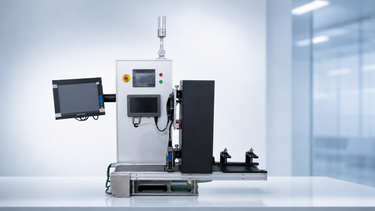
7. Membrane Vision Inspection NCJC012
The Veldi Automation Membrane Vision Inspection NCJC012 is designed for visual inspection applications in rapid diagnostic test manufacturing. It can be integrated with equipment such as continuous dispensing systems, assembly systems, and reel-to-reel production equipment according to the production configuration.
The system uses a 4K high-resolution camera to identify and locate configured visible defects. Inspection standards can be customized according to the customer's production and QC requirements.
Typical Inspection Capabilities
- Broken membrane detection
- Scratch detection
- Visible dust and foreign-particle detection
- Edge defect inspection
- Curving or deformation inspection
- Configured label sequence/order inspection
- Defect positioning through high-resolution imaging
NCJC012 Technical Specifications
| Inspection Camera | 4K high-resolution camera |
|---|---|
| Inspection Speed | 25–50 pcs/min |
| Power Supply | 110V / 220V, 400W |
| Machine Dimensions | 1178 × 533 × 988 mm |
| HMI | Included |
| Customization | Inspection standards, software functions, and production-line integration can be customized according to project requirements. |
8. What Should Manufacturers Consider When Selecting a Vision Inspection System?
The camera resolution alone does not determine whether an inspection system is suitable for a production line. Manufacturers should consider the complete inspection requirement.
- Defect type: What defects must the system identify?
- Minimum defect size: How small is the defect that needs to be detected?
- Material format: Is the product supplied as sheets, assembled panels, or continuous rolls?
- Production speed: Can inspection keep pace with upstream equipment?
- Acceptance criteria: Can the judgement standard be adjusted according to the manufacturer's QC requirements?
- Line integration: Does the system need to communicate or physically connect with dispensing, assembly, or other automation equipment?
- NG handling: How should non-conforming products be identified, rejected, or recorded?
Defining these requirements before equipment configuration is particularly important for customized lateral flow test manufacturing lines.
9. Vision Inspection Is One Part of a Complete Quality Strategy
Machine vision is effective for detecting configured visible defects, but not every factor affecting lateral flow assay performance can be evaluated from an image.
For example, membrane capillary flow characteristics, biological reagent activity, antibody binding performance, conjugate release, assay sensitivity, and finished-test stability require appropriate functional or analytical testing.
A robust quality strategy therefore combines material qualification, controlled dispensing, process monitoring, visual inspection, dimensional control, functional testing, and final product QC rather than relying on a single inspection method.
Conclusion
As lateral flow test manufacturing moves toward higher throughput and greater automation, maintaining consistent inspection standards becomes increasingly important. Machine vision provides manufacturers with a practical way to identify repetitive visible defects, reduce dependence on subjective manual judgement, and add an automated QC checkpoint to the production line.
For NC membranes in particular, early identification of scratches, breakage, dust, edge defects, deformation, and other visible abnormalities can prevent defective material from continuing into later manufacturing processes.
The appropriate inspection solution, however, should always be configured around the actual product, defect criteria, production speed, and upstream and downstream equipment.
Need to Add Vision Inspection to Your Lateral Flow Test Production Line?
Veldi Automation provides equipment and customized automation solutions for rapid diagnostic test manufacturing, including dispensing, lamination, cutting, cassette assembly, pouching, and membrane vision inspection.
Learn more about the Membrane Vision Inspection NCJC012 or contact our team to discuss your product format, inspection requirements, and production capacity.
Blog Information
Leave your contact information and tell us what equipment or raw materials you are looking for. We will contact you as soon as possible to help you provide the most suitable solution.
- +86 13671664698
- inquiry@veldiautomation.com